 Don't’
Bear the Summer Heat; Head to a COOL ZONE Don't’
Bear the Summer Heat; Head to a COOL ZONE
By Pamela B. Smith, Director, County’s Aging & Independence
Services
This past May, paramedics were called to assist 16 older adults suffering from
heat exposure. And it wasn’t even summer yet.
Many seniors don’t realize that they are more susceptible to the effects
of heat than younger people.
They can be in crisis and not know it because seniors often don’t start
sweating until their temperature has already soared. This is especially true if
they have any disease that causes poor circulation. Different medications can
affect the body’s ability to cool down, as well.
This is the fifth year for the County’s Cool Zone program. The main goal is
to educate older adults on how to avoid succumbing to the summer heat. One of
the ways is to spend the hottest part of the day in a cool place.
Remember the Summer of 2000? Seniors and others suffered, physically and
financially, as a result of an energy crisis that shook the entire state. The
costs to keep cool exceeded the budgets of many older adults on fixed incomes.
And that summer was a scorcher. Because of the increased use of fans and other
coolers, California suffered its largest planned blackout since World War II.
Supervisor Dianne Jacob, whose District 2 includes some of the hottest areas
in the County, was concerned for the health of East County residents,
particularly seniors. She realized that some of the frail elderly were deciding
between paying for medicine or treating themselves to air conditioning.
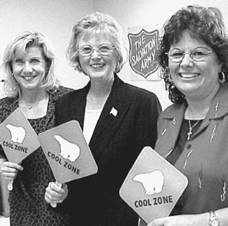 She
set into motion a plan to help prevent seniors and others from risking their
health and hurting their pocketbooks during any future heat wave. Cool Zones
were born. The County’s Aging & Independence Services (AIS) staff members
identified air-conditioned sites in East County and elsewhere for people to
gather on hot days. She
set into motion a plan to help prevent seniors and others from risking their
health and hurting their pocketbooks during any future heat wave. Cool Zones
were born. The County’s Aging & Independence Services (AIS) staff members
identified air-conditioned sites in East County and elsewhere for people to
gather on hot days.
Not only do the sites help seniors avoid heat stroke and other heat-related
problems, the older adults can save money by not using their own air
conditioners or fans. The community benefits, as well, by decreasing the risk of
power blackouts caused by so many individuals using energy at the same time.
The listing of Cool Zone sites has grown steadily each year from 60 to more
than 130. Many of the sites offer activities along with a cool environment,
providing an important social connection. People can make new friends and have
lunch at Cool Zones that are nutrition sites, for instance. The list also
includes libraries, senior centers, malls and more.
SDG&E has partnered with the County on the Cool Zone program, providing
participants with information about other energy-saving devices and cost-saving
programs.
More than anything, Cool Zones provide an opportunity to remind older adults
about the risks of heat and to provide them with:
- Eat lightly and drink plenty of fluids. Non-caffeine and non-alcoholic
beverages help prevent dehydration.
- Wear lightweight, light colored and loose fitting clothing.
- Keep a container of cool water nearby and use wet washcloths to pat the
wrists, face and back of neck or, for a quick cool down, wrap ice cubes in a
washcloth.
- Use small battery operated hand-held fans and misters for a cooling
break.
- Schedule outside activities in the early mornings or in the evening.
- Stay in the coolest part of the house - usually on the lowest floor - as
much as possible.
- A shady spot outdoors may be cooler than the house, especially if
there’s a breeze.
- Use portable and ceiling fans in frequently used rooms to substitute for
the air conditioner.
- If it is safe to do so, leave windows open at night. Open windows on two
sides to create cross ventilation.
- Place a piece of cardboard covered with aluminum foil in sunny windows
to reflect sunlight and heat away from the house.
- Close shades or draperies on sunny windows.
- Air out hot cars before getting into them.
Visit a Cool Zone on hot days!
To find a designated Cool Zone near you, contact the AIS Call Center at:
(800) 510-2020 or visit www.sandiego.networkofcare.org and click on the Cool
Zone polar bear logo.
|
