|
San Diego County ’s AGING & CAREGIVERS INFO
Learning About the New Drug Plan
Pamela B Smith, Director, Aging & Independence Services
You should have already received mail from Medicare (Centers for Medicare & Medicaid Services – CMS) and possibly from the Social Security Administration
concerning Medicare Part D.
This mail concerns the upcoming Medicare prescription drug coverage otherwise known as Part D which
is now in effect. Unlike with the recent Medicare drug cards, this new prescription drug plan will affect every beneficiary in some way. You should know your options. You may later regret not paying attention now.
The letters you receive should direct you on what to do, and they will tell you how to find out more information. But thanks to information from the nonprofit Health Insurance Counseling and Advocacy Program (HICAP), here are some of the possible scenarios:
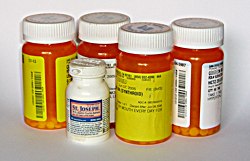 If you have Medicare and Medi-Cal, without a share of cost , your current prescription drug benefit will be eliminated from Medi-Cal on Jan. 1, 2006, and replaced by Medicare Part D. On Oct. 15, 2005, you will be randomly assigned to a prescription drug plan. You can switch plans, however. You should carefully review your assigned coverage because not all plans will pay for all medications. On any plan you choose, your premium and deductible will be covered, but you will have a copayment of between $1 and $3 per prescription/refill (depending on your income level), which you didn’t have before. If you have Medicare and Medi-Cal, without a share of cost , your current prescription drug benefit will be eliminated from Medi-Cal on Jan. 1, 2006, and replaced by Medicare Part D. On Oct. 15, 2005, you will be randomly assigned to a prescription drug plan. You can switch plans, however. You should carefully review your assigned coverage because not all plans will pay for all medications. On any plan you choose, your premium and deductible will be covered, but you will have a copayment of between $1 and $3 per prescription/refill (depending on your income level), which you didn’t have before.
If you are above the income limit for full Medi-Cal, but are still low-income (below 150 percent of the Federal poverty guidelines), you will receive a letter from the Social Security Administration before the end of August with an application for extra financial help with drug plan costs. It will be worth your time to apply for this low-income subsidy and the sooner the better so your eligibility can be determined before you need to select a Part D drug plan. The financial help will cover or reduce your premium, based on a sliding scale. It will also reduce your copayments and other costs. You will be able to enroll in a Part D plan between Nov. 15 and May 15. There is a penalty for applying after May 15, 2006, which will be described later.
If you have an annual income of more than $14,355 for an individual or $19,245 for a married couple and are not in an HMO, you will be receiving a mailing in October announcing the Medicare Part D program and providing a description of plans that will be available in California. Again, not all medications will be covered by all plans, so check these plans carefully for the medications you use . As with the group above, you can enroll Nov. 15 through May 15. The monthly premium for the first year is expected to be $37; plans with additional benefits will have higher premiums.
Plans will have a formulary, a list of covered drugs. The basic monthly premium would cover medications in this formulary (taking into account copayments and deductible). If the medications you use are not covered in this formulary, you still might be able to get them and pay a higher premium. But if your plan does not cover the medications at all, you will have to pay for the drugs yourself and the cost of these medications would not count toward your copayment and deductible requirements. So, again, select your plan wisely.
The deductible will be $250 for drug costs per year (for covered drugs only). The copayment will be 25 percent of the next $2,000 in drug costs. Then there is what has been called the “donut hole” where there is no coverage after your costs get above $2,250 until you reach what is considered “catastrophic coverage” at $5,100 in drug costs in any one year. At that point, 95 percent of all drug costs would be covered. During the “donut hole” phase, you would still need to pay your premium and the total costs of the medications, but you would receive no benefits.
If you have a Medigap policy that already has drug coverage , you will receive a letter after Sept. 15 and before Nov. 15 from your insurance company saying whether your current coverage is considered “creditable” or “at least as good” as Part D coverage. If your policy is not as good as Part D and you have no other coverage that is as good, you would have to pay a penalty for enrolling in a Medicare prescription drug plan if you decide to do so after May 15. Your options would be to keep your Medigap plan, but without the drug coverage; switch to a different Medigap plan that doesn’t have drug coverage; enroll in what’s being called a “Medicare Advantage Plan,” such as an HMO; or keep your current Medigap policy as is (talk with your insurance company about any potential changes to your policy first).
If you have drug coverage through a union or company retirement plan , your plan will be sending you a letter telling you if your coverage matches Part D coverage. If it doesn’t you may want to enroll in a Medicare Part D plan to avoid future premium penalties.
If you have a Medicare HMO, your current drug coverage will end Jan. 1, 2006. Some HMOs will include the Part D benefit as part of the regular premium, others might charge separately for it. This fall, you will be getting a notice from your HMO about your prescription drug coverage. Depending on how extensive your costs are for medications, you may want to look at what all the HMOs plan to cover.
The penalty if you don’t join a Medicare prescription drug plan before May 15, 2006, unless you have drug coverage that is at least as good as Part D : Medicare intends to penalize you an increase of 1 percent in the cost of the premium for each month you don’t enroll after May 15. So, if you wait a year to sign up (May 2007), your premium would be 12 percent more per month than if you had signed up during the initial enrollment period.
Aging & Independence Services is not directly affiliated with the federal programs of Medicare or Social Security. But almost all of our clients are, so we try to be helpful when they have questions about their benefits. Because we’re so accessible through our Call Center at (800) 510-2020, people contact us anyway with concerns linked to their benefits.
Last month, Mark McClellan, the director of the Centers for Medicare & Medicaid Services (CMS), made a
brief whistle-stop in San Diego to deliver a pep talk to representatives of agencies that help seniors and other Medicare recipients because he knows how challenging it will be to educate everyone sufficiently about the new Medicare changes. He’s counting on the largess of the Aging Network to learn the intricacies of the plan and reach out to those who need help navigating the options.
Our County is fortunate to contract with the Health Insurance Counseling and Advocacy Program (HICAP), which has staff and volunteers who are already presenting talks on the new program, and will be setting up appointments with seniors who need one-on-one assistance.
Tony Potter, who heads up our Health Promotions Team, is the link for the local Access to Benefits Coalition (ABC) that is also working to increase awareness of Part D and help people think through how it will affect them.
Hopefully you can see why you shouldn’t toss these letters away, and why it’s important to learn as much as you can about your options.
For learn more about the low-income subsidy, contact the Social Security Administration at (800) 772-1213 Monday through Friday. Or you can apply online at www.ssa.gov.
For more information about Medicare
Part D, call (800) MEDICAR(E) or
(800) 633-4227, or see www.cms.hhs.gov.
|
